
Home/Blog/Intellectual Disability Agency in Rockville, MD | Family Guide
Intellectual Disability Agency
Intellectual Disability Agency in Rockville, MD | Family Guide
Looking for an intellectual disability agency in Rockville, MD? Learn about disability support services, group homes, autism care, and family resources.

Article
How to Find the Right Intellectual Disability Agency in Rockville, MD
Finding the right support for a loved one with an intellectual or developmental disability is an important family decision. Every individual has different abilities, interests, challenges, and personal goals. Some people may need assistance with everyday activities, while others may benefit from community participation, residential support, skill development, or help managing daily routines.
For families in Rockville, Maryland, choosing the right care provider involves more than finding an agency that offers disability services. It means identifying an organization that respects individual choices, understands personal needs, promotes independence, and provides a supportive environment where people can feel valued.
An experienced intellectual disability agency in Rockville, MD can help individuals and families explore appropriate support options and build a plan around everyday needs and long-term goals.
However, not every provider offers the same services or approach to care. Some agencies focus on residential support, while others provide personal assistance, community activities, respite care, or additional services. Understanding these differences can help families make informed decisions.
This guide explains what intellectual disability agencies do, which services families should consider, how to evaluate a provider, and what to look for when choosing disability support in Rockville, Maryland.
What Is an Intellectual Disability Agency?
An intellectual disability agency is an organization that provides services and support to individuals with intellectual disabilities. Depending on its qualifications and service offerings, an agency may assist people with daily living activities, personal care, communication, social participation, independent living skills, and community involvement.
Intellectual disabilities can affect areas such as learning, reasoning, problem-solving, communication, and adaptive functioning. The level of support required varies from one individual to another.
Some adults may live independently with occasional assistance. Others may need regular support with household activities, personal routines, healthcare coordination, or residential living.
A reliable intellectual disability agency in Rockville, MD should understand that disability support cannot follow a single approach for everyone. Services should be based on the person's abilities, preferences, support requirements, and individual goals.
The purpose of quality disability support is not simply to complete everyday tasks for someone. It is to help individuals participate in their communities, develop useful skills, make meaningful decisions, and enjoy a better quality of life.
Why Choosing the Right Disability Support Agency Matters
Choosing a disability support provider can influence many aspects of an individual's everyday experience.
The right agency can help create opportunities for personal development, social relationships, community participation, and greater independence. It can also provide families with guidance and reassurance when coordinating support for a loved one.
Here are some important reasons why choosing the right provider matters.
1. Individualized Support
Every person has different abilities, interests, and support requirements. A person may need help preparing meals but be completely independent with other activities. Another person may need assistance with communication, transportation, or personal routines.
A good provider takes time to understand these differences rather than applying the same service plan to everyone.
2. Personal Choice and Independence
Adults with intellectual disabilities should have opportunities to make decisions about their daily lives.
These decisions may involve choosing meals, selecting activities, managing routines, deciding how to spend free time, or participating in community events.
A person-centered agency encourages individuals to express their preferences and participate in decisions about their support.
3. Safe and Respectful Environments
Safety, dignity, and respect are essential parts of disability services.
Families should look for providers that maintain appropriate safety procedures, communicate openly, train their staff, and treat every individual with compassion.
4. Family Communication
Families often play an important role in supporting adults with intellectual and developmental disabilities.
An agency that maintains clear communication can help family members understand service arrangements, discuss concerns, share important updates, and participate in planning when appropriate.
Types of Services Offered by Intellectual Disability Agencies in Maryland
Before choosing an intellectual disability agency in Rockville, MD, families should understand the different types of services available.
The services provided depend on the agency's qualifications, licensing, staffing, and approved service offerings. Individuals may also have different support options depending on their eligibility and authorized plans.
1. Community Living and Group Home Services
Community living services help adults with intellectual and developmental disabilities participate in everyday life within a residential setting.
For some individuals, a community-based group home can provide an opportunity to live in a supportive environment while developing daily living skills and building relationships.
Depending on the approved service arrangement, support may include:
Assistance with everyday household routines.
Support with meal planning and preparation.
Help maintaining personal hygiene.
Guidance with household responsibilities.
Opportunities to develop independent living skills.
Assistance with social activities and community participation.
Support with maintaining healthy daily routines.
A suitable residential environment should feel welcoming, comfortable, and respectful.
Families evaluating community living services should ask about staffing arrangements, supervision, emergency procedures, individual privacy, daily routines, and opportunities for residents to make personal choices.
The goal should be to create a living environment where adults feel respected and have opportunities to participate in decisions about their homes and everyday activities.
2. Personal Support Services
Personal support services help individuals manage everyday activities while maintaining as much independence as possible.
Depending on the person's needs and authorized services, assistance may involve:
Personal hygiene and grooming.
Dressing and daily routines.
Meal preparation.
Household activities.
Shopping and errands.
Organizing daily schedules.
Developing practical life skills.
Participating in community activities.
A good personal support approach focuses on encouraging individuals to complete activities they can manage independently while providing assistance when needed.
For example, a support professional may help someone learn how to prepare a simple meal instead of completing the entire activity on their behalf.
These small learning opportunities can gradually improve confidence and independence.
3. Community Development Services
Community participation is an important part of a meaningful life.
Community development services can help adults with disabilities explore interests, develop social connections, and participate in activities outside their homes.
Activities may include:
Visiting community centers.
Participating in recreational programmes.
Exploring hobbies and interests.
Attending social gatherings.
Practicing communication skills.
Participating in educational opportunities.
Developing relationships with other community members.
The right intellectual disability agency in Rockville, MD should recognize that community involvement is about more than simply attending activities.
It is also about helping individuals build friendships, express themselves, discover interests, and feel included in their communities.
4. Respite Care Services
Caring for a family member with an intellectual or developmental disability can involve significant responsibilities.
Family caregivers may need time to manage personal commitments, attend appointments, rest, or spend time with other family members.
Respite care provides temporary relief for caregivers by arranging support for the person receiving care.
Depending on the provider and authorized service arrangements, respite support may be available for planned periods or specific caregiving situations.
Families considering respite care should ask about:
Available respite arrangements.
Staff experience and training.
Scheduling and service availability.
Individual support requirements.
Emergency procedures.
Communication with family caregivers.
Respite care can help families maintain a more balanced caregiving routine while ensuring that their loved ones continue receiving appropriate support.
5. Nursing Support Services
Some adults with intellectual and developmental disabilities may have additional healthcare or medical support needs.
Nursing support may help address specific health-related requirements, depending on clinical needs, professional qualifications, and authorized services.
Families should ask whether the agency provides nursing support directly or coordinates with qualified healthcare professionals.
Important considerations include staff credentials, medication-related procedures, health monitoring responsibilities, documentation, and emergency response arrangements.
It is also important to understand the difference between non-medical personal assistance and professional nursing care.
A suitable provider should clearly explain which services it can offer and when additional healthcare professionals may be required.
6. Transportation Support
Transportation can make a significant difference in an individual's ability to participate in community life.
Adults with disabilities may need assistance traveling to appointments, community activities, educational opportunities, shopping locations, or other important destinations.
Transportation-related support may involve:
Planning travel arrangements.
Assistance with accessing transportation.
Support during community outings.
Coordination of appointments.
Encouraging safe travel habits.
Helping individuals participate in local activities.
When evaluating transportation services, families should ask about accessibility, availability, staff assistance, safety procedures, and service coverage.
Reliable transportation support can help reduce barriers to community participation and make everyday activities more accessible.
How to Choose the Right Intellectual Disability Agency in Rockville, MD
Finding a provider is only the first step. Families should carefully evaluate whether an agency's services, staff, communication practices, and support approach match the individual's needs.
Here are seven important factors to consider.
1. Check Licensing, Certification, and Provider Qualifications
One of the first steps is verifying whether an agency is appropriately licensed, certified, or approved for the services it advertises.
In Maryland, the Developmental Disabilities Administration (DDA), part of the Maryland Department of Health, plays an important role in supporting people with intellectual and developmental disabilities.
Families exploring DDA-funded services should verify the provider's status and the specific services it is authorized to deliver.
Do not assume that every organization advertising disability support is approved to provide every type of service.
You can explore official Maryland provider resources through the Maryland DDA website.
Ask the agency about:
Relevant licenses and certifications.
DDA provider status, where applicable.
Approved service categories.
Staff training requirements.
Policies for safety and quality.
Experience supporting people with similar needs.
Verifying these details can help families make more informed decisions.
2. Understand the Agency's Experience
Experience is another important consideration when selecting a disability support provider.
An agency should understand the everyday challenges that individuals and families may encounter when coordinating care.
Ask how long the organization has provided disability-related services and what experience its staff have with different support needs.
For example, families seeking support for an adult with autism may want to understand whether the provider can accommodate communication preferences, sensory needs, familiar routines, and individualized approaches.
An agency should be willing to explain its experience honestly without making unrealistic promises.
3. Evaluate Staff Training and Professionalism
Support professionals often work closely with individuals throughout their everyday routines.
Their communication style, patience, reliability, and understanding can strongly influence the quality of support.
Ask about staff recruitment, background checks, training, supervision, and ongoing professional development.
Important areas may include:
Person-centered support.
Disability awareness.
Communication strategies.
Personal care assistance.
Safety and emergency procedures.
Medication-related policies, where applicable.
Supporting individuals with autism.
Respecting privacy and personal boundaries.
A qualified support team should understand that every individual deserves to be treated with dignity.
4. Look for a Person-Centered Approach
Person-centered care is one of the most important qualities to look for in an intellectual disability agency in Rockville, MD.
Rather than focusing only on a person's disability or limitations, person-centered support considers their strengths, interests, preferences, and personal goals.
For example, one individual may enjoy cooking and want to become more confident preparing meals. Another may prefer music, gardening, sports, or community activities.
A personalized support approach should consider these interests when developing daily routines and support goals.
Maryland DDA describes person-centered planning as a process that helps individuals identify their vision of a good life, personal priorities, goals, and appropriate supports.
Families can learn more through the Maryland DDA Person-Centered Planning resource.
When speaking with an agency, ask how individuals participate in decisions about their support and how personal preferences are reflected in service planning.
5. Review Safety and Quality Practices
Safety should never be overlooked when selecting a disability support provider.
Families should understand how the agency handles emergencies, concerns, incidents, and changes in an individual's needs.
Ask about:
Emergency response procedures.
Staff supervision.
Incident reporting.
Safeguarding policies.
Health and safety practices.
Communication during emergencies.
Procedures for reporting concerns.
For residential support, families should also ask about the physical environment, accessibility, privacy, supervision, and daily living arrangements.
A responsible agency should be able to explain its procedures clearly.
6. Consider Communication and Family Involvement
Good communication helps build trust between families and support providers.
Families should know whom to contact when they have questions, how updates are shared, and how concerns are addressed.
A reliable agency should encourage appropriate family involvement while respecting the individual's privacy, preferences, rights, and decision-making authority.
Before choosing a provider, ask:
How frequently are service updates provided?
Who is the main contact person?
How are concerns handled?
Can families participate in planning meetings when appropriate?
How are changes in support requirements communicated?
Clear communication can help avoid misunderstandings and support better coordination.
7. Ask About Flexibility and Individual Needs
Support requirements may change over time.
An individual may develop new skills, explore different interests, experience health changes, or need additional assistance with everyday activities.
A good agency should be willing to discuss how it responds to changing needs within its authorized service arrangements.
Ask whether the provider reviews support plans, communicates with relevant professionals, and works with the individual's support team.
The right provider should focus on helping individuals move toward their goals rather than expecting them to fit into a rigid routine.
Understanding Maryland DDA Services and Eligibility
Families searching for an intellectual disability agency in Rockville, MD may also come across the Maryland Developmental Disabilities Administration.
Understanding its role can help families navigate available support options.
The Maryland DDA is part of the Maryland Department of Health. It supports eligible individuals with intellectual and developmental disabilities through a range of community-based services and support arrangements.
DDA services are intended to help individuals participate in their communities and pursue meaningful personal goals.
What Is the Maryland DDA?
The Developmental Disabilities Administration works with individuals, families, service coordinators, and qualified providers to support people with developmental disabilities.
Its approach emphasizes individual choice, community participation, and person-centered services.
Depending on eligibility and the applicable programme, support may include residential services, community participation, employment-related support, personal assistance, and other approved services.
How Does DDA Eligibility Work?
Not everyone who contacts a disability agency automatically qualifies for DDA-funded services.
Eligibility is determined through the state's established application and review process.
The process may involve documentation relating to the individual's disability, functional needs, and other applicable eligibility requirements.
Families should contact Maryland DDA or a qualified Coordinator of Community Services (CCS) to understand the current requirements and application process.
An agency can explain its own services and may help families understand whom to contact, but families should not assume that contacting a provider automatically establishes DDA eligibility.
What Is a Coordinator of Community Services?
A Coordinator of Community Services, commonly called a CCS, helps eligible individuals navigate services and coordinate their support.
The CCS plays an important role in helping individuals and their teams understand available resources, planning requirements, and service options.
Families should understand the difference between a CCS agency and a direct service provider because their responsibilities are not necessarily the same.
You can find official information about DDA services, eligibility, and provider resources through the Maryland Department of Health.
Why Autism-Informed Support Is Important
Autism is a developmental condition that can influence communication, social interaction, sensory experiences, and everyday routines.
Autistic individuals have different strengths, preferences, and support requirements. Some may need assistance with daily activities, while others may benefit from support with communication, transitions, social participation, or managing changes in routine.
Families looking for an intellectual disability agency in Rockville, MD should ask whether the provider has experience supporting individuals with autism when this is relevant to their loved one's needs.
Good autism-informed support may involve:
Respecting individual communication preferences.
Understanding sensory sensitivities.
Maintaining helpful routines.
Preparing individuals for changes.
Encouraging personal interests.
Supporting social participation.
Recognizing individual strengths.
Providing opportunities for independent decision-making.
For example, an individual who finds unfamiliar environments overwhelming may benefit from gradual introductions to new activities.
Another person may communicate more comfortably through visual information, written instructions, or other preferred communication methods.
The right provider should be willing to understand these differences rather than expecting every person to respond in the same way.
How Disability Support Can Promote Independent Living
Independence does not mean that a person must complete every activity without assistance.
For adults with intellectual disabilities, independence can mean having greater control over everyday decisions and receiving the right level of support to participate in activities they value.
An effective intellectual disability agency in Rockville, MD should recognize that independence develops differently for everyone.
For example, support with daily living skills may help individuals:
Prepare meals: Learning to select ingredients, follow simple recipes, and practice kitchen safety.
Manage household routines: Organizing personal belongings, keeping living spaces comfortable, and participating in household responsibilities.
Make decisions: Choosing clothing, activities, meals, and daily schedules.
Build communication skills: Expressing preferences, asking for assistance, and communicating personal needs.
Develop social connections: Participating in community activities and building meaningful relationships.
Explore personal interests: Discovering hobbies, recreational opportunities, and activities that bring enjoyment.
These everyday experiences can contribute to confidence, self-expression, and a stronger sense of belonging.
Questions to Ask Before Choosing a Disability Support Agency
Before making a decision, families should arrange a conversation with the provider and prepare questions about services, staffing, safety, and individual support.
Here are some useful questions:
What disability support services does your agency provide?
Are you licensed or qualified to provide the services my family member needs?
Do you have experience supporting adults with intellectual disabilities and autism?
How do you develop individualized support plans?
How are individuals involved in everyday decisions?
What training do your support professionals receive?
How do you handle emergencies and unexpected changes?
How do you communicate with families and other members of the support team?
What residential or community-based options are available?
How do you evaluate service quality and respond to concerns?
Are your services available in the Rockville area?
What are the next steps for discussing service availability and eligibility?
The answers can help families understand whether the agency's approach matches their expectations.
It is also useful to request information about service availability, costs, funding arrangements, and any applicable waiting periods.
Why Families in Rockville, MD Should Consider Local Disability Support
Choosing a provider familiar with the local community can make it easier to discuss nearby resources and participation opportunities.
Rockville is part of Montgomery County, Maryland, where individuals and families may explore different community, recreational, educational, and support resources.
Local knowledge can be helpful when planning activities, accessing transportation, coordinating appointments, and identifying opportunities for community participation.
However, families should not choose an agency based only on its location.
The most important considerations remain the quality of support, service qualifications, individual preferences, staff experience, and availability.
When researching an intellectual disability agency in Rockville, MD, families should confirm whether the provider actually serves their location and can accommodate the individual's support requirements.
How Sparkling Care Inc. Supports Adults with Disabilities
Finding the right disability support provider is about finding an organization that understands the importance of dignity, personal choice, and meaningful everyday experiences.
Sparkling Care Inc., based in Rockville, Maryland, focuses on supporting adults with intellectual and developmental disabilities, including individuals with autism.
Its person-centered approach emphasizes the importance of creating supportive experiences that reflect individual needs and encourage participation in everyday life.
Depending on individual requirements and service availability, families can explore support areas such as community living, personal support, respite care, nursing support, community development, and transportation.
Supporting Everyday Living
Everyday activities can provide valuable opportunities to develop confidence and practical skills.
Support with personal routines, household activities, and daily responsibilities can help individuals participate more actively in their lives.
The goal is to recognize what each person can do while providing appropriate assistance where needed.
Encouraging Community Participation
People with disabilities deserve opportunities to participate in their communities, explore interests, and build relationships.
Community participation can include recreational activities, social experiences, and opportunities to develop new skills.
Sparkling Care recognizes the importance of support that goes beyond basic daily assistance and considers the value of meaningful community involvement.
Respecting Individual Needs
No two people have exactly the same abilities, interests, or preferences.
A supportive environment should recognize these differences and respect individual choices.
For adults with intellectual disabilities or autism, this can mean understanding communication preferences, maintaining familiar routines, and creating opportunities to participate at a comfortable pace.
Working with Families
Families often have valuable knowledge about an individual's routines, preferences, strengths, and support requirements.
Open communication can help build a stronger understanding of what matters most to the person receiving support.
Sparkling Care encourages a supportive approach that recognizes the importance of individuals, families, and care professionals working together where appropriate.
Families interested in finding an intellectual disability agency in Rockville, MD can explore Sparkling Care Inc. to learn more about its services and discuss their support requirements.
Common Mistakes to Avoid When Choosing an Intellectual Disability Agency
Finding the right provider takes time. Families should avoid making decisions based only on advertising or convenience.
Here are some common mistakes to watch out for.
Choosing based only on location: A nearby agency may be convenient, but its services may not match the individual's needs.
Not checking qualifications: Always verify relevant licensing, certifications, and provider approvals.
Ignoring individual preferences: The person receiving support should have an opportunity to express their choices and participate in decisions.
Overlooking staff training: Ask about the experience, qualifications, and supervision of support professionals.
Not discussing safety procedures: Families should understand how the provider handles emergencies and reports concerns.
Assuming every service is included: Agencies may offer different services, and availability can vary. Confirm the exact support arrangements before proceeding.
Failing to ask about communication: Families should understand how they can contact the agency and receive appropriate updates.
Taking time to evaluate these factors can help families select a provider with greater confidence.
Final Thoughts: Finding the Right Disability Support in Rockville, Maryland
Choosing the right support provider is an important step toward helping adults with intellectual and developmental disabilities live meaningful, fulfilling lives.
The best agency is not necessarily the one that offers the largest number of services. It is the one that understands the individual, respects personal choices, maintains appropriate safety practices, and provides support that reflects real everyday needs.
Families researching an intellectual disability agency in Rockville, MD should carefully consider service qualifications, staff experience, person-centered planning, communication, safety, and opportunities for independence.
It is equally important to involve the individual receiving support in the decision-making process as much as possible.
With the right support, adults with intellectual disabilities can explore their interests, develop everyday skills, build relationships, participate in their communities, and enjoy greater control over their lives.
If your family is exploring disability support options in Rockville, Maryland, Sparkling Care Inc. can be a starting point for learning about available services and discussing individual support needs.
Looking for personalized disability support in Rockville, MD?
Visit Sparkling Care Inc. to explore its services for adults with intellectual and developmental disabilities, including autism.
Contact the team to discuss your family's needs and learn more about available support options.
Disclaimer: This article provides general educational information and is not a substitute for professional medical, legal, or eligibility advice. DDA eligibility, service authorization, provider qualifications, and service availability should be confirmed with the appropriate Maryland authorities and service providers.
FAQs
Frequently asked questions
Find answers to common questions about this topic.
← Previous
Intellectual Disability Agencies in Rockville, MD | Choosing a Provider
Next →
DDA Waiver Services Explained: Maryland Family Guide
Continue reading
Related articles
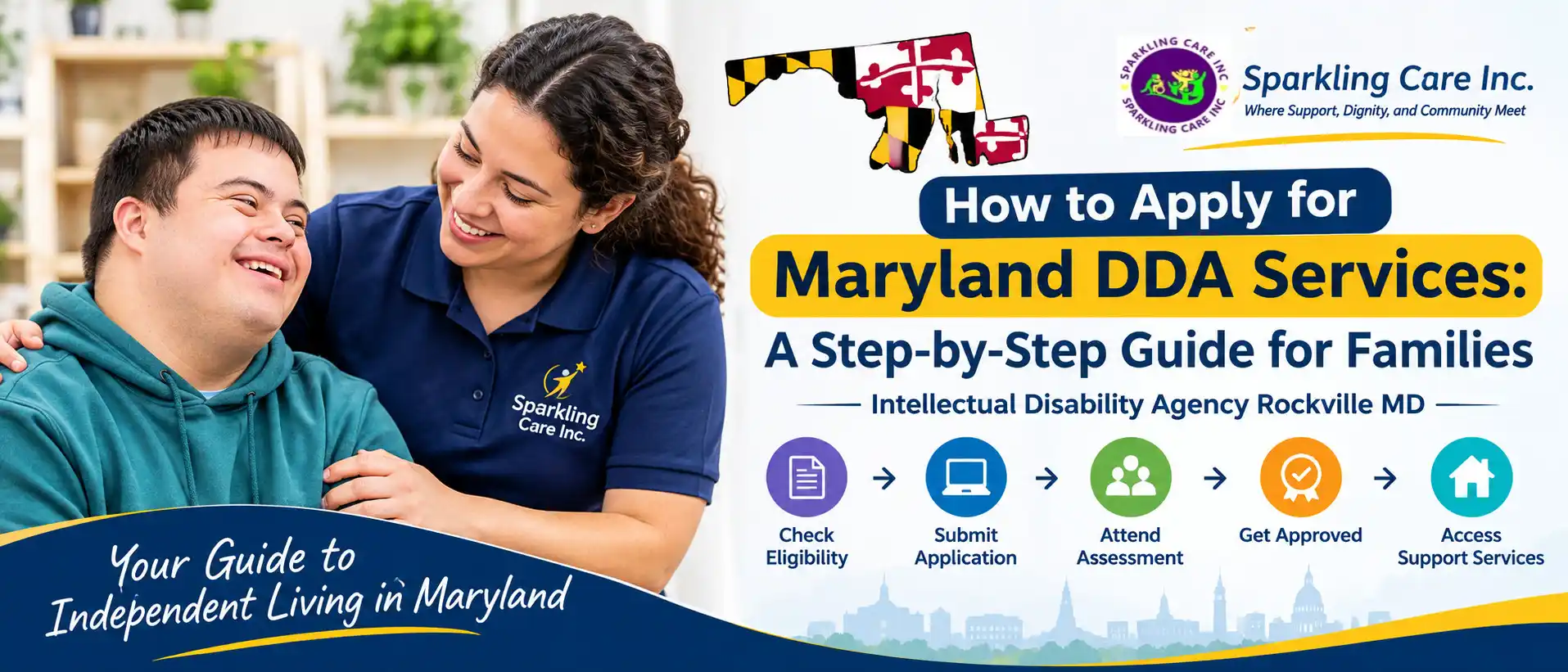
How to Apply for Maryland DDA Services: A Family Guide
Learn how to apply for Maryland DDA services, understand eligibility requirements, prepare documents, and find disability support in Rockville, MD.
.webp)
What Does an Intellectual Disability Agency in Rockville, MD Do?
Discover what an intellectual disability agency in Rockville, MD does, from personal support and residential care to community development and respite services.

Questions to Ask an Intellectual Disability Agency MD
Choosing an intellectual disability agency in Maryland? Discover 15 important questions about DDA approval, services, staff, safety, and support.